dnsPolicy: Default is not the default
One word in a pod template, and the pod can't resolve a single cluster Service.
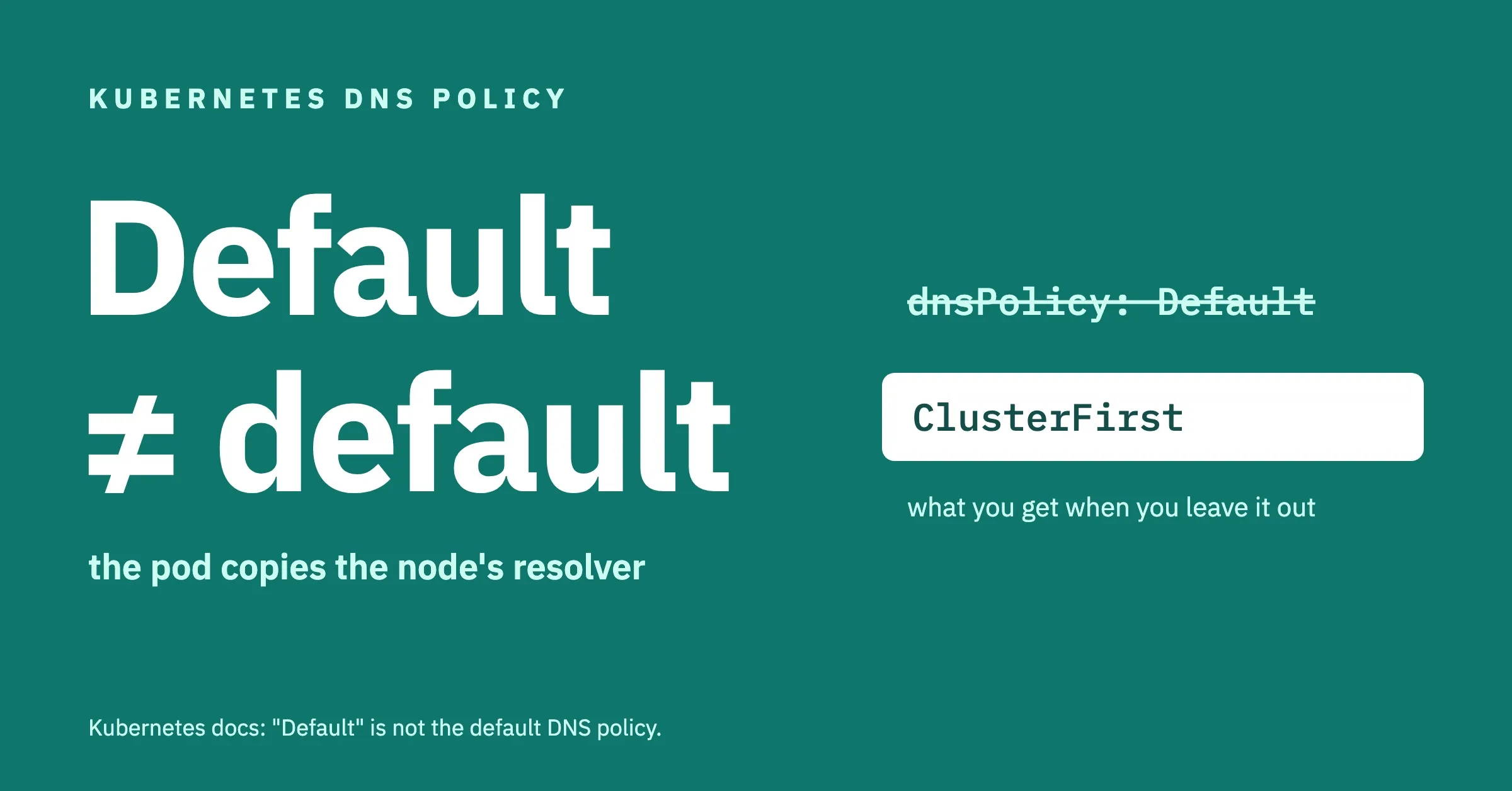
Kubernetes has 4 DNS policies, and the one named Default is not the default. dnsPolicy: Default makes a pod copy the node's /etc/resolv.conf, which may not resolve cluster Service names even when public DNS works. The real default, the one you get when you leave the field out, is ClusterFirst. If you find Default in a pod template you own, the fix is usually to delete the line.
The note
The Kubernetes docs page on DNS for Services and Pods has a note under the list of policies. Word for word:
"Default" is not the default DNS policy. If
dnsPolicyis not explicitly specified, then "ClusterFirst" is used.
Somebody on the docs saw this trap coming and wrote one sentence to stop it. I read that sentence the day I deleted the word from a pod template. Until then I had read dnsPolicy: Default the way most people would: as "leave it as is".
What each policy does
| Policy | Where queries go | Resolves my-svc.my-ns.svc.cluster.local? |
|---|---|---|
ClusterFirst (the real default) | cluster DNS (CoreDNS), which forwards anything outside the cluster domain upstream | yes |
Default | whatever the node uses | depends on the node resolver |
ClusterFirstWithHostNet | cluster DNS, for pods on hostNetwork: true | yes |
None | only what you put in dnsConfig | only if you configure it |
With Default the pod inherits the node's resolver config. If the node's resolver does not know your cluster domain, my-service.my-namespace.svc.cluster.local can fail even when public names work. A check that only tests the internet can miss the problem. Some node resolvers are configured to resolve cluster names, so check your setup.
flowchart TB
  subgraph cf [ClusterFirst]
    direction LR
    A[pod] --> C[CoreDNS] --> S[Service IP]
  end
  subgraph df [Default]
    direction LR
    B[pod] --> N[node resolver] --> X[may not resolve]
  end
  cf ~~~ df
  class X bug
Same name, same pod. The resolver changes; the answer depends on the node DNS configuration.
Who Default is for
If it breaks Service names, why does it exist? Look at CoreDNS. The upstream manifest in the Kubernetes repo sets dnsPolicy: Default on the CoreDNS pods. The DNS server can't ask itself where to find upstream DNS, so it takes the node's resolver. It is useful for pods that need the node resolver rather than cluster DNS.
So Default in a system add-on is normal. In an application pod that needs Service names, check whether the node resolver can resolve them.
The host network twist
There is a second way to end up on the node's resolver without writing Default at all. A pod with hostNetwork: true and the default ClusterFirst falls back to the Default behavior. The docs say you should set ClusterFirstWithHostNet explicitly for those pods. So of the 4 values, the one named Default and the one you get without asking on host network both use the node resolver unless other DNS settings change it.
How to spot it
Inside the pod, read the resolver config:
kubectl exec -n my-ns my-pod -- cat /etc/resolv.confA ClusterFirst pod looks like the docs example: the cluster DNS Service IP as nameserver, a search line with <namespace>.svc.cluster.local svc.cluster.local cluster.local, and options ndots:5. A missing cluster search suffix is a clue that short Service names may fail, not proof of which resolver is in use. Cluster domains and custom DNS settings can differ. Check the nameserver too, and query a fully qualified Service name.
To find every pod that sets it across a cluster:
kubectl get pods -A -o json \
  | jq -r '.items[] | select(.spec.dnsPolicy=="Default") | "\(.metadata.namespace)/\(.metadata.name)"'
Expect CoreDNS in the list. Anything else deserves a second look, and so does any hostNetwork: true pod still on ClusterFirst:
kubectl get pods -A -o json \
  | jq -r '.items[] | select(.spec.hostNetwork==true and .spec.dnsPolicy=="ClusterFirst") | "\(.metadata.namespace)/\(.metadata.name)"'
The fix
- Application pod that needs cluster DNS and does not intentionally use the node resolver: remove
dnsPolicy: Default. A non-host-network pod getsClusterFirst. - Pod on
hostNetwork: truethat calls Services: setdnsPolicy: ClusterFirstWithHostNet. - Pod that really needs custom resolvers: use
Nonewith an explicitdnsConfig, so the next reader sees exactly what it gets.
What I kept
I now read any field whose value is literally "Default" as a specific mode, not as "the default". The one-line note in the docs was right there the whole time. Deleting one word took less time than reading it.
Credits and links
- Kubernetes docs: DNS for Services and Pods, Pod's DNS Policy
- Kubernetes docs: Customizing DNS Service
- CoreDNS manifest in kubernetes/kubernetes,
dnsPolicy: Default
Nahum Litvin, Lead Platform Engineer.
Read next
Krew is K8s Game Changer!
KubernetesMy first open source PR was 3 lines
Kubernetes
Comments